Author: sfdancematters

April 10th, “Pilot 67, 22:16″

Choreography by Many

 Pilot 67 is a program by ODC that provides a performance venue and framework for emerging artists.  Each choreographer is mentored by a professional choreographer and ODC staff in their artistic work, production, and promotion.  I enjoyed this program last year, but it was a challenge to write about all six pieces presented.  I feel them same about this year’s Pilot 67.  So my responses here will be brief, but hopefully reflective and not merely reactive.
File_000


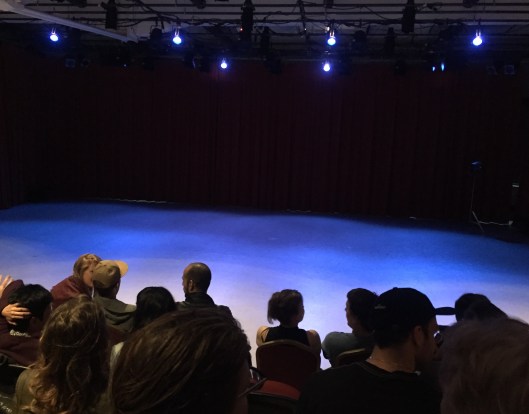
Dolly would, Garth Grimball

I could sense the thinking in this piece, a commentary of sorts on the possibility and wish of connection.  Why not?  Why not a skinny ballet dancer and a not-so-skinny club dancer?  Why not a silent dancer and a singing companion?  These juxtapositions reminded of Miguel Gutierrez show last year at CounterPulse. The weaving in of Pat Benatar’s “Love a battlefield” made sense as well as the including “would” in the title; they highlighted the why not character of the dance and the sometimes struggle to find (and maintain) relationships with others.  Even though it was a little rough around the edges, I could see the possibility here.

Gen, Ryan, Inez, Dylan, Salome, or Quinn, hers and hers

The literal and metaphorical unpacking in this piece was very particular, but at the same time universal as a narrative of perfection and “in control” was read (and danced).  With the addition of song refrains like “you don’t own me,” the danced asked the audience to fill in the blanks, to supply the cultural assumptions about what makes (or marks) identity, which linked the dancing, narrative, and music.  Like Dolly would, I could sense the thinking in this piece.

Cora, Under and Above, Marika Brussel

The dance world needs more female ballet choreographers, and more female choreographers in general.  There is an on-going conversation out there that I will write about later as lately I’ve been spending a good deal of time watching the San Francisco Ballet.  So watching Brussel’s piece is complicated for me.  While the pieces by hers and hers and Grimball were thinking through or with ideas, Brussel’s piece didn’t articulate the same level of thinking.  I kept trying to figure out what I was watching – why did it matter?

Myth of the Manta, Amelia Uzategui Bonilla

Bonilla’s piece seemed to matter, but more to her than the audience.  I appreciated learning about the textile she used in the dance: “A Cusquerñan textile is the starting point for a ritual honoring the evolving stories of growing up within immigrant culture.”  I had hard time connecting with it, and I’m not sure why.  More story?  Less textile?  

weather // body, Arletta Anderson & Adam Smith

Anderson and Smith created an atmosphere of light and play with their piece.  Their particular mix of wit (sound, text, movement, & light) led me to think about different kinds of illumination that reveal and conceal our perspectives of events, stories, places, etc.

Motion Picture, Helen Wicks

Another piece of more or less.  Choreography that sits between extremes can work. This was not the case with Motion Picture, it’s aesthetic seemed obscured, not illuminated enough toward one extreme or another.  More camp?  Less reference?  Wicks’ idea to the use of movie scores from 1940-1969 has potential, however.
April 7th, “Program 7”

San Francisco Ballet, choreography by Christopher Wheeldon, Justin Peck, and George Balanchine

Watching Dance with Dad

Some of my earliest memories of watching dance are with my Dad.  The most vivid was seeing Pilobolus Dance Theater when I was about 13 or 14.  At the time, it was the “newest” kind of dance I had ever experienced.  The dancers slid across a wet stage for their curtain call; they were mostly naked.  It was odd, and I loved it.  As a ballet dancer in training, I didn’t know dance could be so big and different.

So when my Dad came to visit in April and mentioned that he really wanted to see the ballet, we ended up at the San Francisco Opera House for Program 7.  My Dad is an artist – although he might not call himself that – so he sees movement differently and notices relationships between moods, colors, and music that I might tend to ignore while watching dance.  It was fun to notice how my perspectives on the 3 dances moved the more my Dad and I talked about the pieces we saw.

File_002 (5)


My Dad really liked Christopher Wheeldon’s Continuum – there was something there to relate to.  Maybe it was the clean stage and lighting or the way the choreography embodied the music.  There was an ease to the dancing that made its abstractness relatable, the “art” in the dance.  In the program notes, Wheeldon states that “audience’s shouldn’t just be entertained.  They should be challenged.”  While I can’t say for sure whether or not I was challenged by Continuum.  I did enjoy watching it with my Dad; he didn’t shy away from bursts of happy.

People are talking about Justin Peck’s, In the Countenance of Kings.  Even Vanity Fair has something to say or rather ask: “Is Justin Peck Making Ballet Cool Again?”  I’m not sure how I would answer this question, but it seems to imply that there is something “uncool” about ballet or maybe that ballet is, as Jennifer Homans claimed in her 2010 book Apollo’s Angels, dying.  Does Peck’s  growing popularity serve as a refutation this claim?   

Underneath the question posed by Vanity Fair is a fear – or the perception of a fear – that ballet is becoming irrelevant or less relatable to our present moment, which begs the question: Is In the Countenance of Kings relevant?  How does it matter?

In the program notes Peck states, “it’s not a narrative, but it’s like a semi-story.”  There is a protagonist, foil, and hero.  The corps de ballet is “the school of thought” and there are three others, Quantus, Electress, Botanica.  I’m not sure the names of the “semi-story” matter, but should they?  In the Countenance of Kings is a “semi-story” of a present moment that is “cinematic” with “freeze-frame kodak moments.”  There is a relatable surface here, but it is just that, a surface that is just skimming the possible and ways of perceiving the possible.  I want Peck to be more than “be cool,” and I want this dance to matter more because I truly like how Peck cuts the stage with his choreography.  For the record, my Dad only liked the second ½ of this dance.

Last on the program was Balanchine’s Theme and Variations.  My Dad really liked this piece – the tutus, the symmetry, the classical lines – I wasn’t surprised.  The woman sitting next me asked her partner if they could leave: “Oh god, not Theme and Variations.”  This begs the question: is Theme and Variations relevant? How does it matter?  For me, it was enough that my Dad enjoyed the dance – it mattered enough at the moment.   

Thanks Dad.

March 26th, “Lauda Adrianna”

Stephen Pelton Dance Theatre, choreography by Stephen Pelton from movement devised by the company

Music – the haunting laude by Gavin Byrars was deeply felt.  Bearing witness to a process of grieving, of sorting through loss and pain of emptiness.  Considering the afterness of passing.

There are perhaps other things to say in response to this piece – like a poem – but I think I will let this one just sit as it is, and be thankful to witness.    

File_000 (17)

P.S. I know there was a lot Bay Area History that also sat with me in the audience, I could feel (and see) it, but didn’t feel like writing that part.  Sometimes dances just need to be.

March 17th, “Program 5”

San Francisco Ballet, choreography by Jerome Robbins and Yuri Possokhov

Sitting in Row E.


File_000 (16)

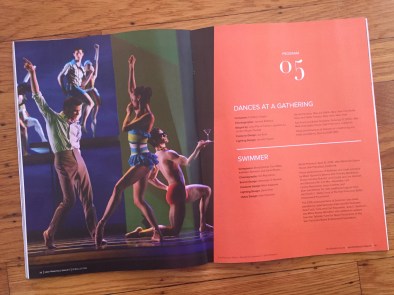
In big theaters, I don’t choose to sit this close – Row E – but for this performance I did.  Sitting here, I could watch the detailed movements of the feet and even the sweat on faces and backs.  It was a perfect location to take in all the delicate surprises of Dances at a Gathering.  The subtle gestures and weight shifting were delightful, and I reveled in live accompaniment – Chopin.  I could have watched that piece again and again.  It was one of those dances that I could see myself dancing.  I felt close to this piece; I wanted to touch it.

Row E was not the perfect location, however, to watch Swimmer; I am not sure there was a perfect location.  Confession: I did not read the program notes.  Hindsight: I should of read the program notes.  A week later, I am still trying to figure out why people like this piece. I just couldn’t connect with it.  Yes, there was some good dancing, but I couldn’t figure out what the dance was saying or asking. What was I being asked to consider or think about? I don’t mind when a dance makes me work, but I do mind when a dance only seems to be speaking for itself.   

It took me a while to figure this out.  When asked how I felt about this piece my gut responses were, “waste of resources” and “too much going on.”  Yet, as I sat lingered with the dance (including the program notes) for a bit, I realized my discontent was rooted elsewhere.  The program notes suggest that the thinking behind the piece works from “deeply personal experiences,” which are left for the viewer to make any interpretation.  Yet, I didn’t get the sense that I was invited into to these experiences, into Possokhov’s concepts, point-of-views, etc.   Instead, I was just watching from a distance.  

Often, there is already enough distance between the dancing and audience when sitting in the theater.  The differences in watching (and writing about) these two pieces reminded me that the presence and action of distance can matter in dance, which can be deeply personal, highly contextual, and even physical.  

March 10th, “Analogy/Dora:Tramontane”

Bill T. Jones/Arnie Zane Dance Company, choreography by Bill T. Jones with Janet Wong and the Company

Bill and I have been seeing each other for a while.

I first saw the Bill T. Jones/Arnie Zane Dance Company in 2006 when they performed Blind Date in Madison, WI.  I was in graduate school, and eventually, the dance became a central feature in one chapter of my dissertation.  Since then, I’ve also seen Chapel/Chapter, Fondly Do We Hope…Fervently Do We Pray, A Rite, and Story/Time.   I’m did not read any reviews before seeing this piece, but I did take the time to listen to this interview with Jones on KQED’s Forum with Michael Kransy.  In it, Jones claims that this piece is a departure for the company.  I am not sure how much of  a departure this piece is from the others I’ve seen – abstraction of storytelling, text, and movement all seem to be at play in this work too.  This work is a story and a telling of that story via Jones (with Janet Wong and the Company).   There is no doubt that Jones is telling this story.


File_000 (15)

First, some orientation (thanks to the program notes).  Analogy/Dora; Tramontane is based on the oral history conducted by Bill T. Jones with Dora Amelan, “a ninety-five-year-old-French-Jewish women” recently “awarded the French legion of Honor of her World War II activities as part of O.S.E., a Jewish organization dedicated to saving children that was first established in 1917 and went underground in France during the war’s occupation.”  

Like most pieces I’ve seen by Jones, I found myself watching with my ears and listening with eyes.  There is a distinct abstraction between what is being spoken or sung and what is happening on stage.  The text, Amelan’s oral history, is spoken out loud by different dancers as they move about the stage – her story has more than one voice – it moves.   Amelan’s history unfolds as a series of vignettes accented by the mobile set pieces that are rearranged by the dancers.  Perhaps invoking the labor of history/memory making.  I don’t remember much about the dancing; it seemed to get eclipsed by the abstract storytelling and striking music (performed live by Nick Hallett and Emily Manzo).  Jones, it seems, likes to make his audiences work and because of that, the lovely dancing doesn’t always get noticed.  Brian Siebert’s review of Analogy/Dora; Tramontane in the New York Times only devotes 4 sentences to the dancing.  I am still trying to figure out if this is ok.

Since seeing this piece, I can’t help but think about my German grandparents; they survived WWII along with my mother.  They never liked to talk much about their experiences.  So much of their histories were willfully lost.  I wonder – there must be countless untold stories.  Is history ever complete?  Who gets to tell history’s stories?  Who owns history?

In many ways, this is what Jones does best – he provokes questions.  More accurately, he brings audiences to questions by re-making and abstracting stories, histories, and politics.  For now, this is enough to keep me coming back to his work.

February 13th, “Ondine”

The Cutting Ball Theater

File_000 (14)

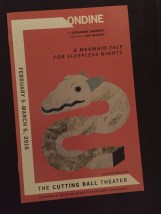
I went to this play on the recommendation of someone I met in a laundry mat.  I texted a friend, and within an hour we had tickets.  Again, I went for the experience of being with others.  The performance seemed secondary.   I wonder how often this happens – how many people sitting in a theater are there because they want to be others (for whatever reason)?  After the show, we did talk about the production, performance,  and writing, but what mattered more was that we were together.  Sometimes it seems that what lingers after is not the story, actors, sets, music, or costumes, but the connections between people and the exchange of thinking, feeling, and musing.   This was an evening well spent even if the company lingered more than the performance.


February 4th, “Program 2”

San Francisco Ballet, choreography by George Balanchine, Mark Morris, Liam Scarlett

Back to the SF Opera House.

File_000 (13)

I saw two San Francisco Ballet programs last season – both full length pieces (Giselle and Schokovitch Trilogy).  I didn’t write much about the dancing in either ballet.   This year started I with a mixed repertory program: Rubies (Balanchine), Drink to me with Thine Eyes (Morris), and Fearless Creatures (Scarlett).   I rather enjoyed “the whole” of the evening; it was nicely curated.  The pieces were abstractly similar even if they come out of different times and represent different aesthetics.  I got a little nostalgic with Rubies (1967) – some Balanchine choreography can do that to me.  Learning and performing Concerto Barocoo back in 1987/1988 was an incredible experience, and sometimes when I watch Balanchine’s choreography I enjoy (and appreciate) the work happening on stage.   I got a little dreamy watching Drink to me with Thine Eyes (1987).  There was buzz about Fearless Creatures (2015); I heard a rumor about standing ovations.  I watched a lot of creature in this piece but wanted more fearless.  A quick read through the program notes confirmed this observation: “anti-venom to the fairies;” “synergy within them (the dancers) as a pack;” “something prowling.”  I think our world needs more fearless right now, but I also understand and appreciate time spent in the beauty and wonder of a dance.  “Program 2” was a pleasant surprise, and I’ve got my fingers crossed that the next SF Ballet program will be just as tight and maybe a little more fearless.

January 22nd, “Rice”

Cloud Gate Dance Theatre of Taiwan

I got a slow start this year.

2016 started with words about dance.  I attended two discussions as a part of the Fresh Festival (“Phenomenology & Feminisms, or Ladies Night with Fauxnique Monique Jenkinson” and “Dance Discourse Project #21: Dreaming the Future Landscape”).  I’m not sure what I expected out of these events.  I wasn’t sure what I was supposed to “do” as an audience member/participant, and I wasn’t sure what I was supposed to take home with me.  Maybe I chose the wrong talks (unfortunately, I didn’t have much choice in my schedule).  Maybe the they needed better facilitators.  Maybe I needed to participate more.

Now, for the dancing – Cloud Gate Dance Theatre. I bought this ticket last Fall, and it was a little weird to have this on my calendar for so long.  I am usually not thinking that far in advance.

CalPerformance program.

If I could only choose one word to describe “Rice,” it would be “satisfying.” Beautiful dancing, rhythm, video, light, sound – all of it was satisfying.

As I learned from the program notes, the choreographer, Lin Hwai-min, took his dancers to join farmers harvesting rice in the field.  It tells “the story of the land while contemplating the devastation of Earth.”  I don’t know how, but this showed up in the dance. I could sense it.  Perhaps what I found so satisfying had something to with how these dancers embodied soil, wind, pollen, sunlight, grain, fire, and water via the experiences of death and rebirth, devastation and resurrection.  The program notes also suggest that the dance “enacts a human drama parallel to the life cycle of rice.”  But is this all?  As I pressed start on my rice cooker today, I began to reflect back on the performance as something more than just a satisfying experience.  What might it mean to be watching laboring dancers embodying the human and non-human labor of rice production?  Is this aspect of labor eclipsed by the beauty of moving bodies and images?  If so, why?

It’s often so easy to sit in the audience and be satisfied with the beauty of a dance.  But dance doesn’t only exist in the theater or in program notes.  Dances connect to experiences, identities, communities, ideologies, questions, and more.  They ask us to think differently, consider alternative worlds, explore new concepts, and imagine other ways of being.  Yet, the theater can isolate the experience of watching and even detach us from those connections.  Yes, watching “Rice” was satisfying, but its labor gives me pause and in that pause I am confronted by multiple kinds labor and laboring that are visible as well as invisible.