June 10th, “Manifesting (World Premiere) and Stay (2015)”

Choreography by Hope Mohr

Almost Caught Up

The first weeks in June were busy, but I’m almost caught up now.  I saw Hope Mohr Dance three times last year.  Mohr is a sharp a choreographer curator, and director.  I am definitely looking forward to her work in the 2016 Bridge Project at Yerba Buena Center for Arts in the Fall.  

Mohr is not afraid to think nor is she afraid to show the audience how she thinks.  In many ways, Manifesting, is about thinking, about the process of thinking.  It is also a dance about speech, of calling out and being called. Mohr states that Manifesting, “inspired by artist manifestos, flows from [her] curiosity about the interplay between desires and rules in the creative process.” So it is also a dance about moving between woulds (desires) and shoulds (rules).  Manifest, an adjective, suggests something that is clear or obvious whereas manifest, a verb, suggests the display or show of something.  A manifesto, a noun, is a public declaration of change that arises out of a tension between creative impulses and restrictive norms.

What, then, is manifesting?  What kind of action? What kind of process?

I liked walking into the theater and seeing the stage look different with conference tables, low lighting, and telephones.  It looked more like an office than a stage.  I got a giggle from the costumes as it reminded me of an old joke: what is red, white, and black all over?  (answer: a newspaper).  The written word is referenced not only in the costumes but also in the dance as Mohr incorporates spoken word and singing.  It seems then that manifesting as it is articulated in the dance has something to do with the actualization of words.  The refrain, “please speak louder” amplified this notion for me.  Because I am writing this from many weeks past my watching the details of the choreography are a bit fuzzy and then I wonder if this has to do with the abundance of words in the piece.

I didn’t take too many notes of Stay and when I saw it last year, I didn’t write about the details of the piece.  I remember liking its sexiness and sophisticated movement, and this time, I felt a little less of this.  Why repeat this dance? Why did it’s repetition matter?  I wonder if it has something to do with the need to fill time.  Why not just show Manifesting?  I ask these questions because I talked with a few people afterwards (at the theater and on the bus), and they seemed a little weary.  Did Mohr ask too much from her audience?  Maybe and maybe not.  Even so, I’m still a fan.   

June 3rd & 4th “Walking Distance Festival”

Choreography by Many

Writing Out of Sequence

I’m a little out of sequence posting this response – lots of dance at the beginning of June.  I’ve watched and written this festival for 3 years.  This year, The program consisted of two different experiences: an evening of theater dance and an afternoon of site-specific dance.  

In her program notes, Marie Tollon (ODC’s Writer-in-Residence) framed the Friday night’s program as “Identity as a Constellation,” which aptly captured the thematic connection between the two performers, Nā Lei Hulu I Ka Wēkiu and Christopher K. Morgan.  Both share a connection to Hawaiian tradition in contemporary contexts.  In their dances, these connections were forged in direct ways, explicitly leading the audience to consider communal and individual journeys by dancing and talking.  In this context, the talking by Nā Lei Hulu I Ka Wēkiu director, Patrick Makuākane in between the dances.  I learned a lot about the hula dance tradition and was interested in how Makuākane uses the language of hula to participate in political conversations.  For example, Makuākane choreographed The Birth Certificate Hula in 2012 in response to the “controversy” over Obama’s birth certificate.  Yes, even hula can be rhetorical.

After Nā Lei Hulu I Ka Wēkiu I walked from the ODC dance commons to the ODC By Way to watch Pohaku.  The two companies met in the street and performed a ritual – it seemed fitting.  Pohaku, choreographed and danced by Morgan also included talking.  Morgan and danced and narrated this dance theater piece that brings “together storytelling, hula, modern dance, classical music, and projection design to explore compelling universal themes in the story of Hawaii’s native people, including land loss and fractured identity.”  I didn’t think much about this piece.  So I tried to seek out a little more information and watched this short video about the piece.  I found much more interesting than the dance itself. I wonder what makes a dance more interesting to watch in the process of making than to watch in performance.     

Saturday afternoon the festival included for the first time a set of site-specific dances all over the mission.  Titled, “Mission Street Dances,” the audience was led to six different locations to see dances by Smith/Wymore, David Herrera Performance Company, 13th Floor, ODC/Dance, Dance Brigade, and Kim Epifano’s Epiphany Productions.  I enjoyed much of what I watched including the streets.  The small duets by ODC/Dance dotted the route between the six dances that were mostly staged outside in a park, parking lot, storefront, alley, and side of a building.  There was talking, singing, dancing, and more.  I really didn’t have a favorite dance, but I did enjoy the afternoon of walking and watching, and I enjoyed seeing dances that I had never seen such as Dance Brigade and 13th Floor.  The pulse of the street was felt in both expected and unexpected ways.  

June 11th, “60 Second Dances”

Curated by Melissa Lewis, Choreography by Many

There was a warm buzz in the tiny Book & Job gallery on Saturday night.   On view was a debut photography show, Multiples, by Melissa Lewis.  Lewis states that the “show is an attempt of understanding what a multiple is.”  I came on Saturday night not only to see Lewis’ photographs but also to watch “60 Second Dances.”  Lewis commissioned and curated 21 dancers/choreographers to make one-minute responses to each of her photographs that hung in the gallery.  

File_001 (13)

The dances extended the show’s theme as a reflection of multiples upon multiples – an interplay of different parts, an arrangement (or composition) that allowed for more than one connection.  Even Geary St. added a sonic/atmospheric multiple.    

What does a 60 second dance look like?  I’m not sure I have an answer, but for me it wasn’t about the individual dances. I was more interested in how “the whole” of these pieces came embodied a collective response to Lewis’ photographs.  As I moved around the tiny room trying to watch these dances, I started to see them as parts of a larger conversation.  In this conversation, I noticed humor, delicacy, honesty, peculiarity, and others.  The connections made between the dances and photographs were explicit and implicit, as well as reactive and reflective – a speaking of wishes, desires, and whimsey.  

There was something tender about the 20 or so minutes of dance, which might be indicative of Lewis’ personal connection to each of the performers or how her photographs included so much of herself in them.

I wonder how my response fits into the conversation.  Is this response here part of the multiples?  Could I dance it?  I truly appreciate dance experiences that can provoke me to think in new ways not just about dances, but about how I respond to them.   

File_000 (21)

May 29th, “The Dionysian Festival”

Mary Sano and her Duncan Dancers, Megan Nicely

Music and Sound by Benjamin Akela Belew, Tony Chapman, and Erick Scheid

Watching my  4 Year-Old  Watch Dance

Yes, I took my daughter.  We went to see our friend, Megan Nicely, dance and were pleasantly surprised to also see so much variety on the program: small kids performed, original works for piano were played and butoh-inspired dance presented.   I’ve taken my daughter to see dance before, and I keep trying.  She got a little tired toward the end (we only stayed for the first ½).  But when Nicely took the stage she focused and even tried to mimic some of her movements – it was pretty sweet to watch my 4-year-old try to embody  my friend’s dancing.  Sometimes the best shows are not necessarily about the dancing as dancing.  Sometimes the best shows are about how they generate experiences that linger.  I’ll never forget this moment of watching my daughter watching my friend’s dancing.  

0001-347x450

May 26th, “10th Anniversary Home Season”

Little Seismic Dance Company, Choreography by Katie Faulkner

Sometimes it’s hard to write about a choreographer or a dancer you know.  Other times it’s easy, and this evening one of those times.  I’ve known Faulkner since 2007; we met shortly after I moved to San Francisco.  I was always struck by her generous spirit and playful sense of humor, which were on stunning display Thursday night.

Aptly titled “Deep Field,” a solo performed by Faulkner, was an embodiment of profound reflection about a history of process and a particular field of communication.  The sonic and visual landscape by Michael Trigilio and Heather Stockton respectively amplified the autobiographical nature that Faulkner so clearly danced.  Even without the choreographer’s note, Faulkner’s movements spoke – each gesture, glance, vibration – from the inside out.  It was personal, but relatable – a clarity of telling that I could feel in my bones.

“Coat of Arms” induced small bursts of laughter from the audience – a kind of seismic response.  The subtle gazes and slight gestures performed with such stunning precision created a witty duet that reflected the universal quirk of relationships.

The last piece, “Don’t Worry Baby,” was harder to grasp, harder to feel.  It was more sculptural than the other pieces and as a result it felt different.  While superbly danced the piece for me seemed a little distant or disconnected somehow.

Faulkner closed her choreographers note “with gratitude,” and that is how I felt at the end of the evening.  I left the theater with an overwhelming sense of gratitude for Faulkner’s choreographic vision and courage to put so much of herself on stage. It was an honor that I can’t wait to repeat.

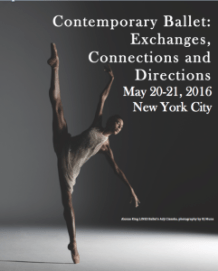
May 20 – 21st “Contemporary Ballet: Exchanges, Connections and Directions”

Special Topics Conference – Society of Dance History Scholars.

I often sit outside of dance studies, yet on occasion I transverse into this vast area of study that can include performance studies, choreographic practice, dance theory, dance history, dancelong-2 criticism, and many other topoi.  My latest adventure into dance studies was a conference on contemporary ballet sponsored by the Society of Dance History Scholars.  The organizers, Jill Nunes Jensen, and Kathrina Farrugia-Kriel, aimed for the conference to continue conversations about the “efficacy of [contemporary] ballet, its history, locality, and relevancy” by including practitioners, scholars, critics and “those who work across those categories as well as in-between.” To their credit, the conference did include a variety of perspectives on contemporary ballet culture, curating, making, and writing.

Over the course of the two days I participated in and listened to different conversations around the field and practice of contemporary ballet.  Not surprisingly, these conversations seemed constrained by institutional frameworks and linear thinking, and I noticed a striving to locate alternative narratives and discourses.  Whether I was listening to dance history scholars, dance program directors, choreographers, or researchers in other fields, I felt an urgency not just to mark or name the field of contemporary ballet but to claim it as if it might be in danger of slipping away.

The first plenary, “Contemporary Ballet, Women, and Institutions,” put three academic directors in conversation – Emily Coates (Director of Dance Studies at Yale University), Jodie Gates (Director and Vice Dean USC Glorya Kaufman School of Dance), Jill Johnson (Dance Director at Harvard University.  What struck me about their conversation was a clear turn toward the discursive and yes, rhetorical.  In the varied context of their respective institutions, contemporary ballet emerged as a particular kind of discursive space and way of thinking.  There was a lot of talk about dance practice, but also a lot of talk about the risk-taking “entrapunerial spirit” of dance. I saw this as a persuasive move, to make ballet (and dance in general) more universal and tangible, less ephemeral.  Can ballet and dance survive and be relevant in academic institutions that are increasingly shifting away from the humanities and civic arts?

The second and last day of the conference was a mix of various scholars and practitioners, and looking back on my notes it was hard to call out anything specific that stood out to me. The large field of dance studies seems to enjoy talking with and about itself (maybe most academic disciplines do).  Thomas DeFrantz made this point clear at the beginning of his presentation, “The race of Contemporary Ballet: Interpellations of Africanists Aesthetics.” He claimed that ballet already knows itself or at least it thinks it does.  He might be right, and I could feel it at this conference.  If ballet already knows itself, then why do scholars and practioners feel the need to keep arguing for its history or for marking its (varied) territory?  

If ballet can provoke us to consider the challenges of our present condition (gender, race, inequality, etc.), then maybe it can start to unknow itself a bit more.  Maybe ballet can start to reconsider its search for “the next” balletic genius.  Maybe ballet can start to communicate more about why it matters to others.  There was no closing session, which seemed a missed opportunity for such a small conference.   Without such, it was hard to tell what was gained collectively or how the conversations might be continued.

May 6th, “Program 8: Onegin”

San Francisco Ballet, choreography by John Cranko

Last One

This was my fourth trip to see the San Francisco Ballet this season and my only full-length ballet.  I could feel the storytelling of the Pushkin narrative poem and found myself connecting with the drama as it unfolded out of the choreography.  I think the last lines of the program notes best capture my experience: “it is a joy to watch.”  Even so, this dance doesn’t inspire me to write.  I could write about the quality of dancing, sets, or costumes.  I could write about the choreography or music.  There just isn’t much say.  But I do think there is something to say about San Francisco Ballet now that the season is over.  That, however, will wait until later.   


May 5th, “Tacit Consent”

Choreography by Liss Fain 

I didn’t take many notes for this performance; I didn’t need to.  The idea was simple and executed clearly, and I was able to physically and mentally move through the piece without a lot of unnecessary noise.  I don’t mean to imply that the dance was simplistic because it wasn’t.  Rather, it spoke intelligibly and complexly about surveillance and privacy with a felt playful intimacy that carried throughout the 45-minute piece.

The space at YBCA was divided into four “rooms” by hung walls crafted out of various materials that despite having gaps and slits were illuminated by various projections.  Matthew Antaky and Frédéric Boulay created an impressive physical, visual, and sonic installation.  

File_000 (20)

The program notes pointed out that Tacit Consent is an immersive performance installation.  To see and hear everything you must walk about.”  I rather enjoyed the freedom of moving about and within the performance even if it was impossible to see the whole dance.  It was voyeuristic, playful, and intimate.  And the dancing amplified this experience.  The choreography embodied different kinds of desire for isolation, contact, curiosity, etc. by creating purposeful movement that could be felt from the feet of the dancers to the tops of their heads.  Nothing seemed to be wasted.  This dance was satisfyingly fun.

As the title suggests, there is something to consider about how easily we seem to allow ourselves to be watched and how easy it is to watch others.  What power do we “give up”?   To whom? For what purpose?  Even in all the fun of this dance there is a seriousness that lingers –  in the story of Edward Snowden – in the technology of drones – in the security cameras in our hallways.


April 16th, “echo::system – treadmill dreamtime; running in place”

Choreography by Grisha Coleman

I’m used to going to performances that don’t adhere to traditional or formal performance orientations.  I’m used to walking into a theater space with the performance already happening.  I’m used to sitting on the side of a stage instead of in front of it.  I’m used to not knowing where to fix my gaze while watching.  

However, I am not used to seeing treadmills on stage.

I attended this performance as a singular event, but each afternoon before the show  YBCA offered an interactive installation for people to reflect on their impact on the natural world.  I also  learned, that echo::system – treadmill dreamtime; running in place is the second installment of a “five-part epic.”  The first, “Abyss,” was performed in 2003.  This kind of extended thinking was evident as well as a density that resonated between various aspects of the performance, which included 3D animation, composed music, fragmented screens, and a metal ramp.  Coleman’s team included performers as well as multiple designers and researchers perhaps reflecting her orientation as a Professor of Arts, Media and Engineering at Arizona State Univeristy.  As I watched, I could sense this weight of thinking and making.

File_000 (19)

It’s taken me a while to figure out a response to this dance.  I’ve been sitting with the program notes alongside the scribbles in my notebook.  I think the weight and density of the piece make it difficult for me write as the dance seems to demand some weight in response.  Hence, I start with a question: where is the human?

In the context of echo::system – treadmill dreamtime; running in place, the answer might be found in walking.  Coleman uses walking as her aesthetic impulse: “The choreography depicts an ambulatory narrative that explores the transitional space between urban and “country”environments by following a tribe as they embark on a journey into a mythic desert.”  The human practice of walking is explored in the dance as a technique and ritual.   The grid-like movements reference urban movement that is layered with various groupings, pilings, and processions.  “The human” seems to be located within practices of mobility that have carved out the earth and segmented society.   While I know there is more happening in this piece I just can’t seem to find my way into its density – could Coleman be thinking too hard?

April 14th, “Program 6″

San Francisco Ballet, choreography by Helgi Tomasson, Alexi Ratmansky, and Christopher Wheeldon

Again

File_002

This is the most I’ve seen of a San Francisco Ballet season since moving here in 2007 – 4 so far and 1 left to go.  Again, a mixed repertory program, and again odd programming.  These three pieces (Prisim, Seven Sonatas, and Rush) were very similar, almost too similar.  The program notes highlighted their differences in choreographic approaches, musical choices, and moods, but these differences didn’t provide enough differentiation between the three dances (for me).  Yes, I had a favorite, but it doesn’t really matter as I am not inspired to write about either of these dances.  Yes, there was good dancing, but there usually is good dancing with the San Francisco Ballet. I don’t mind spending time in the beauty of a dance.  I do mind, however, when that is all there is again, and again.  What is there to write or think about?

After I saw Program 2 in February, (Rubies (Balanchine), Drink to me with Thine Eyes (Morris), and Fearless Creatures (Scarlett), I wrote it was a pleasant surprise, but that I wanted more fearless.  

I am still waiting.