Full-Length Dance

April 15th “Prescription Drug Nation”

Here Now Dance Collective

Joshua Kosman, writing for the San Francisco Chronicle, said that “Prescription Drug Nation” didn’t have “much to do with either the corporate or the sociological aspects” of prescription drug use; it wasn’t “a crusading, big-picture slab or reportorial nonfiction.” He claimed the piece was a more intimate look at six of the most common medications on the market: Adderall, Ambien, Xanax, Prozac, Vicodin, and Viagra. I don’t disagree.

Fletcher carefully explores how these drugs affect the body with delicate gestures and attentive facial expressions. These subtle indicators seemed to speak nuanced truths about these drugs from the inside looking out and about how they impact the social field. While there were clear markings between the different scenes (and drugs) such as costume changes and text projections it was not always easy to notice the differences between them. Perhaps that was part of Fletcher’s message. Might she be asking us how these drugs “do the same thing.”

The superb music by Aaron Gervais that was performed by Mobius Trio added moods, tempos, and sounds to the landscape on stage. The music contributed to the waves of alterity that moved in and out of consciousness, elation, attention, and confusion. And yes, the dancing was strong. 

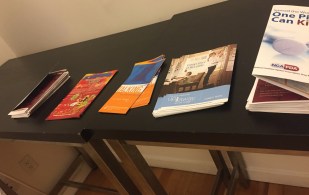
I’m not sure I had any expectations walking into the theater. I did notice the stack of pamphlets about drug safety and awareness on a table in the lobby.
File_000 (27)

Their presence seemed to suggest that “Prescription Nation” just might try to say something or intervene in someway. When it didn’t I was a little surprised. I did leave the theater wondering how many of us experience the world under some kind influence. What might that matter to how we live and are living?

Antigona, February 25th

Where is Antigone?

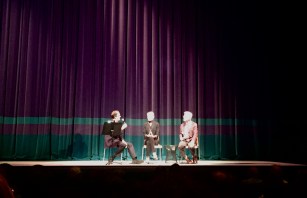
Whenever my brother comes to town we go see some dance. This time, we saw a flamenco version of the Greek tragedy Antigone by Noche Flamenca. It was a feast of sound, rhythm, and drama. It had dancing like I had never seen before. It held my attention from start to finish. I wanted to see it again. I wanted to talk with the director, choreographer. I think there are a lot of questions to ask about this piece.

File_000 (26)

I have a history with Antigone and ancient Greek tragedy. I’ve studied and taught about Antigone. I also wrote about tragedy in my dissertation. So my response is an extension of this history and heavily influenced by my field of study – rhetoric.

I’ve always been drawn to the story of Antigone as told by Sophocles. In 2015, there were 3 productions of the tragedy in the San Francisco Bay area; I saw two of them but only wrote about one. There is something timeless about this tragedy – we keep coming back to its multiple struggles between public and private rights; human laws and law of the gods; duty of kinship and religious obligation. The program notes explain that Antigona addresses the themes of “catharsis, issues of dictatorship, repression, loss, the strength of family and female empowerment,” which are also strong themes in flamenco. The notes end with a reflection on the character of Antigone as a “poster-child for civil disobedience and free speech.” The words behind the piece suggest that Antigona will show the strength of Antigone as a female hero through the language of flamenco.

I was disappointed.

Antigona begins with the story of Creon and his family, and it is not until the 6th scene (out of 15) that the Sophocles’ tragedy actually starts. Sophocles’ Antigone starts with her words, her voice. Antigona’s beginning features the male characters – Creon, Tiresias, Polyneices, Haemon. Even though Soledad Barrio dances a powerful Antigone, her part seems diminished somehow along with the politics that drives the drama. 

Might Antigona rely too much on the language (and culture) of flamenco to tell Antigone’s story? I’m not ready to answer that question for I’d need more knowledge of flamenco not just as a dance form but as a way of thinking. It is a question worth asking especially when so many of us claim Antigone’s story as our own. What is gained? What is lost? Why does it (still) matter? 

2nd Show of 2017 – Slow to Write

Lucinda Childs, “Available Light,” February 3rd.

This post is very, post.

It’s been a busy February. Since seeing “Available Light,” I’ve also been to a play, the ballet, and a flamenco performance piece. So there is more writing to come.

There are several aspects of “Available Light” by Lucinda Childs worth noting and worth reflecting on, but part of what I think makes this one writable for me is how much I enjoyed the planned and unplanned conversations that unfolded throughout the evening. As many of my previous posts reveal, my reflections often are part of conversations that still linger and those I have yet to have. My response to “Available Light” is no different; it is imbued by conversations I’ve had since seeing the show on February 4th. Here are a few brief reflections:

  • There is beauty in repetition, which compels a different kind of focus that directs attention to the cracks and gaps between movements and dancers.
  • The music composed for the piece sounded of waves and other earthly utterings.
  • The piece held together; it seemed like a conversation of movement, sound, and light.
  • I didn’t understand the title until I heard Childs and John Adams, the composer, talking after the performance.

file_000
While I enjoyed the performance I still left the show wondering why bring this piece back. It’s rarely been seen since 1983. It’s not as though Available Light is a timeless piece; its aesthetic age is evident. And as Childs made clear, the dance apolitical and without “a message.” What does Available Light matter to now? Is it’s beauty enough of an answer?

December 16th, “future friend/ships”


By Keith Hennessy and Jassem Hindi, with lighting designer Dennis Döscher

Last post of 2016 

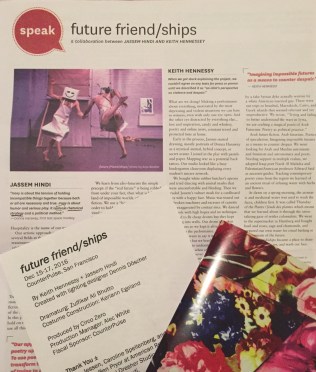
I arrived at Counterpulse early and picked up the December issue of indance. On the last page was an article penned by Hennessy and Hindi about future friend/ships.  They started with this quote:

“Irony is about the tension of holding incompatible things together because both or all are necessary and true. Irony is about humor and serious play. It is also a rhetorical strategy and a political method.

– Donna Haraway, First test space monkey

In their article, Hennessy and Hindi identify their research practice as “ironical” and aim for the dance to “host otherness.” As hosts, Hennessey and Hindi welcomed us on stage before we took our seats and the lights dimmed. As we walked around the stage, we were asked to look at the photos (“a partial tarot deck”) scattered around and sample food they offered on trays. This opening did resonate with the theme of hospitality that they claim “is the name of [their] game.” Later in the piece, they also invited the audience to view the tarot cards again as Hennessey and Hindi passed them through the audience. It left like we were in someone’s living room (the fabric curtain and costumes added to this effect).Another thread that became clear from the “performance/installation/science fiction salon” was the idea of Arab Futurism. A quick google search didn’t reveal much on this emerging genre (?) in contemporary art.

With all this mind, my response attempts to sort out what all this might mean in the context of what occurred (and what I noticed) on stage. In order to do so, I found myself reading through the performance zine and digging into literature about irony.

file_000

When my friend sat down next to me, I turned to her and said, “this is a dance about language.” Reflecting back, I still think this claim captures this piece as whole for me. It is easy to point out the tangible textual elements of the performance such as the use of spoken word and its written manifesto. This piece is also about making, tinkering, and fashioning. In addition to the text, Hennessy and Hindi “made” sound and props, which seemed to fit with their directive to imagine and transform the future. The future made visible in “future friend/ships” is not yet sorted out – the tarot deck isn’t complete, the drones didn’t really work that well, and the dance movement unrefined. When Hennessy and Hindi danced their bodies moved as if they forgotten how to “dance.” They tried out steps (I noticed grande jeté en tournants and temps levé sauté), arms dangled, and bodies dropped to the floor. This movement suggested a kind of scratching-your-head-thinking, which for me is the work of language, which can be thought as a form of making or even invention. All of this might serve to remind us that making the future requires some forgetting, a forgetting that stretches out and strives for possibility.

The ironic nature of “future friend/ships” eludes me, and I wonder if the logic of irony – its movement of strategic reversal can be danced. Hennessy and Hindi might answer yes. I, however, am still wondering, which seems an appropriate way to conclude 2016.

December 10th, The Velveteen Rabbit

Choreography by KT Nelson

This was a sweet and magical night. I took my daughter and she gasped when the Velveteen Rabbit jumped on the stage. I spent most of the show watching her watch.  So for me, this dance mattered because it mattered to my daughter. I was reminded that sometimes the best performances are about how they create experiences that linger. This was definitely one of them.


November 4th, Le grand spectacle de l’effort et de l’artifice

Choreography and Direction by Christy Funsch

I love watching dance that makes me think. I love watching dance that enables conversation about concepts and politics. I love watching dance that surprises me. The evening’s five pieces did just that.

Funsch’s new work explores the blurriness between effort and artifice in an odd, but compelling program. The different sections (Prelude, Part I; Artifice; Path; AfterPath; Part II, Effort) constituted an elegant string of ideas about effort and artifice as practices and as ways of constructing and perceiving the world. The clarity of the movement – the dancing and the choreography – was further realized by the improvised sound, music, and lighting. Together these elements came together to further demonstrate how effort and artifice can sometimes be tricky.

For me, what really brought this nuance out was Funsch’s use of actors on the stage. Two women were set-up in the back, sitting at a conference table. During Prelude, they were actively watching the two dancers (Funsch and Nol Simonse) and taking notes as if they were judging the dancers. Like the judges during a dance and ice skating competition. During Part I: Artifice, the two actors sat still, not taking notes and looking straight forward. They left the stage for Path and AfterPath, returning to the table for Part II: Effort. In this section, they faced each other and did so the entire time. The interplay between the movement, sound, and acting clearly demonstrated that we don’t always see the artifice as artifice or effort as effort – who are we to judge.

Funsch performed Daniel Nagrin’s 1965 solo Path and is the first woman granted permission to do so. Funsch noted that while working on Path “[she] wondered about creating a container for it that could highlight what to [her] is its celebration of ongoingness.” I sat and watched in silence (there was no sound or music) as Funsch held a long wooden beam and moved diagonally across the stage. The movement sequence was simple, a kind of modified jazz square, that was repeated until she reached the corner. I felt a sense of wonder as I watched Funsch with determined focus hold the space (and the wooden beam) and our attention. Was this “pure” effort? Did the piece articulate some kind of truth about the nature of work? What about artifice? The evening ended with an insightful Q & A with all the artists that could have been longer.

I left the theater thankful for an experience that got me thinking about how we see and experience effort and artifice in what many are calling a post-truth world.

October 8th, “Readymade”

Choreographed by Tanya Chianese

I’ll start with a point of reference, a quote by David Batchelor (a Scottish artist and writer) that repeated near the beginning and end of Readymade:

…and, you know, I think the aim of a lot of artists is to get people to look more closely at that which you often overlook.”

The repeating of this quote gave me pause, and I wondered what Chianese wanted us to look at more closely. About mid-way through the hour-long piece something struck me. Could Chianese be asking us to remember that we are the “readymade”? What are we overlooking in ourselves?

As Chianese mentions in her program notes, “Readymade is not about Duchamp’s work, but instead, aims to invoke his iconic idea of the do-it-yourself power to reshape one’s own life by changing how we view things.” This impulse is evident in the titles to the 14 sections of the dance – “What If?”, “Stop and Smell the Roses”, and “You Only Live Once,” for example. I could sense this impulse in the opening of the dance. The movement of afile_000-25rms and bodies in between three wide “ribbons” across the length of the stage hinted at how the intertwining of parts could be a reshaping or refashioning of what we might otherwise overlook.
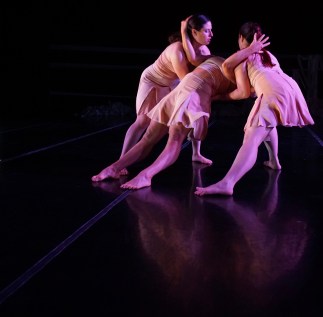
This impulse is also evident at the end when a dancer walks out on stage with a piece of tissue stuck to her foot. She bends down and picks it up, looking as if she might toss it over her shoulder, like a piece of trash. Instead, she sees something else in that piece of tissue and decides with a smile to send it into the sky by blowing on it softly.

The music that accompanies Readymade reflects this whimsical spirit and amplifies the playful yet thoughtful tone of the piece. What is also very clear and uncompromising is the choreography and its execution by the dancers of ka·nei·see | collective. The movement quality was robust both in temperament and reach. The dancers never gave up, committing fully to each change of mood and intensity. The dance almost never stopped, but at one point during a long diagonal sequence, the dancers let their weariness show. I enjoyed the subtle humor and yearned for more. It seems a worthwhile sentiment to explore right now as well as in the context of the dance’s message to pay attention to what we normally overlook in ourselves.  How can we with a bit of humor start to rethink ourselves and how we see the world we’ve made?

dsc06565

Source: Rob Best

Honestly, I wasn’t sure of all this when I left the theater, but an encounter with a friend a few days later opened my eyes to what I might have overlooked in the dance. It was an important reminder to me that I am a much better watcher (and writer) when I am in the company of good conversation about dance.

September 22th, “The Way You Look (at me) Tonight”

Choreographed by Claire Cunningham and Jess Curtis

First a little thank you note:

Thank you for moving to a point to tenderness and offering a moment to reflect on how we come to love (each other). Thank you for offering emotional exchanges about bodies, looking, and feeling. Thank you for trying to speak differently about how seeing and not seeing difference matters.

file_000-23

The program notes frame the piece as a “social sculpture – a sensory journey for two performers and audience…[that asks] important questions about our habits and practices of perceiving each other and the world.” For the most part, The Way You Look (at me) Tonight stays within this frame. Cunningham and Curtis move their bodies and words to confront the sometimes uncomfortable spaces between the perceptions of others and ourselves. They navigate and narrate their own experiences with disability, age, and sexuality, reminding the audience that how we look at others has consequences and that as Diana Taylor says in her book, Performance, looking can be fraught, even risky (79). 

Cunningham dances with remarkable ease (and strength); her crutches are extensions of her body that move with precision and grace. At one point Curtis lies on the floor while Cunningham walks on him with the full weight of her body. During this sequence, Alva Noë’s pre-recorded voice (the philosopher consultant) voice thinks out loud about what he is seeing. I found this to be an unnecessary interruption. Honestly, I don’t really care what Noë saw or what he thought about what he saw, and felt it contradictory to the participatory frame of the piece.

Perception is not just about the eyes and The Way You Look (at me) Tonight examines that by showing us different ways of looking and sensing each other. I think this dance has the potential for genuine learning. I even modified their “game” of peripheral fluctuation, where you keep people in your peripheral vision without directly looking at them, for one of my classes. It really got us talking about how much we are able to see, and how often we chose to not see. I can envision how this dance could be taught alongside texts that aim to explore cultural difference, rhetorical listening, and the politics of perception.  

90 minutes without an intermission is a lot to ask, but I was still happy to go home thinking about love.   

September 22nd, “King Tide”

Choreographed by Nina Haft & Company

It’s been a while, again.

On the recommendation of friends, I walked into the Joe Goode Annex.  Before any dancing started, I saw this:

file_000-2

As I took my seat, I felt immersed by the visual and sonic representations of water.  The title, King Tide, refers to what happens when the moon and sun align to bring about what is more commonly known as high tide.  This theme of water was reflected in all aspects of the dance The three sections made references to water’s action:  “ebb & flow”; “almanac”; and “shrinking ground.”  Haft’s program notes referred to the crisis in our watersheds and climate change.  The brief dancer biographies describe not their dance credentials, but their connections to water.  Haft undertook extensive research (a 3 year process) to make King Tide, which was evident in what I saw on Thursday night.  

The first section, “ebb & flow,” was beautifully composed and performed.  The movement (and sound) expressed not only the ebb and flow of water, but also of time and breath.  It all seemed deliberately slow even when the movement quickened.  I found myself with time to consider how human bodies are also ebbing and flowing as the dancers breathed with their limbs, extending their reach out into the landscape.  For me, there was something very satisfying to slowing down; a different way of being with time.  For the second section, I was brought down to the perimeter of the stage with about ½ of the audience.  Sitting so close it was not hard to notice the strength between the two dancers in “almanac.” It was striking to track their orbits and how they responded to each other.  The last section, “shrinking ground” was aptly titled.  The faces, movements, and lighting all contributed to a sense of closing in, of being pushed back by some force.  The diversity of bodies on the stage added to the human realness of the piece. Sometimes when a piece gets worked on for a long time it looses its edge but this is not the case with King Tide.  There is a maturity of thought happening not only in the choreography, but also between the dancers.  I greatly value this kind of thinking through movement and the research that sits behind the piece.  I wonder what’s next for Haft.  Next time I won’t wait 3 years.  


May 6th, “Program 8: Onegin”

San Francisco Ballet, choreography by John Cranko

Last One

This was my fourth trip to see the San Francisco Ballet this season and my only full-length ballet.  I could feel the storytelling of the Pushkin narrative poem and found myself connecting with the drama as it unfolded out of the choreography.  I think the last lines of the program notes best capture my experience: “it is a joy to watch.”  Even so, this dance doesn’t inspire me to write.  I could write about the quality of dancing, sets, or costumes.  I could write about the choreography or music.  There just isn’t much say.  But I do think there is something to say about San Francisco Ballet now that the season is over.  That, however, will wait until later.